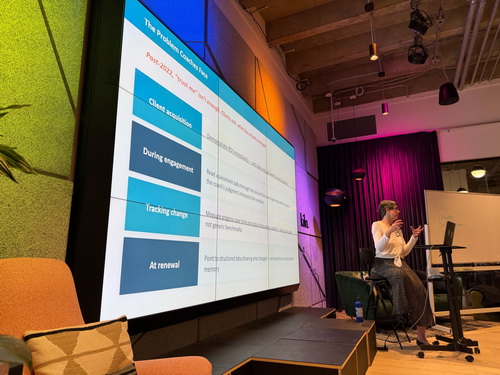
I had the great good fortune to speak to the Women in AI Meetup this week at the incredibly beautiful co-work space, Kiln, in Boulder about CultureCamp AI and the importance of understanding culture in the context of the workplace. It’s a crucial lens for understanding the underlying dynamics that affect team behavior. It can be both enduring and changeable, and it provides invaluable information for getting below the surface of what may look like simple team conflict.
I talked about how organizational culture is MANY things – and what we associate with culture is often a very small piece of the puzzle. I didn’t use the well-worn-out analogy of the “tip of the iceberg,” although it is highly applicable.
I like to think about culture as values-in-action. Because it is both felt and observed as behaviors, rather than as espoused values (or what a company might post on its website).
Because values are embedded in behaviors AND because values are contextual, it can be difficult to distinguish between personalities and culture. In fact, several folks asked if we used elements of popular personality assessments in the CultureCamp AI assessment. We didn’t. Culture is distinct from personality. Personality assessments are valuable for promoting self-awareness in individuals in the workplace.
However, culture assessments look at a different level of analysis. We’re looking at the group as a whole. What are the shared values that drive the behavior of this group? How do we leverage the group’s strengths and how do we manage for their challenges? How does being a highly collaborative group affect the way works gets done? Indeed, the way work MUST be done? When is this an incredible strength and when does this cause the team to stagnate? This is much easier to understand and strategize around when everyone shares a common language and way to discern when that comes up.
This is what fascinates me. It’s not just theoretical. It can be observed, discussed, and it can be changed as personnel change.
On the other hand, there are often enduring cultural characteristics that are NOT changed when the person at the head of an organization or team moves on. I am reflecting on this as I have been volunteering as part of a large group of folks who plan the Conference on World Affairs (CWA) for the past 11 years. Over that time, there have been some big changes in the leadership of the conference as well as among both the community and student volunteers. I’ve ridden out many a conflict over the years.
And while, on the surface, all of these changes seem significant, there’s something that has remained the same through all of the changes. And I believe that it is based on the core values that drive the organizers to put this conference on year after year. We’re hosting an event, by the community, for the community where we bring together folks from various disciplines and perspectives and putting them in conversation with one another. There’s an inherent selflessness that goes into that planning. This doesn’t mean that egos don’t get in the way or that serious conflicts don’t occur. They do – and there aren’t necessarily mechanisms to resolve those conflicts effectively. And many a volunteer has felt underappreciated and left. So, it is, by no means, perfect. BUT we were still able to pull off a beautiful event this year, the 76th year of the Conference on World Affairs. And I’m certain that the folks who stick around have managed to sustain a culture that allows this to happen.
I haven’t had the opportunity to have all of the volunteers for the CWA take the CultureCamp AI assessment, but I am sure it would yield interesting results. How does this organization keep on ticking through all of these changes? What could we do to improve things?
If you have questions like these about your team, reach out to try out CultureCamp AI: alexis@culturecamp.ai
Try the assessment: app.culturecamp.ai